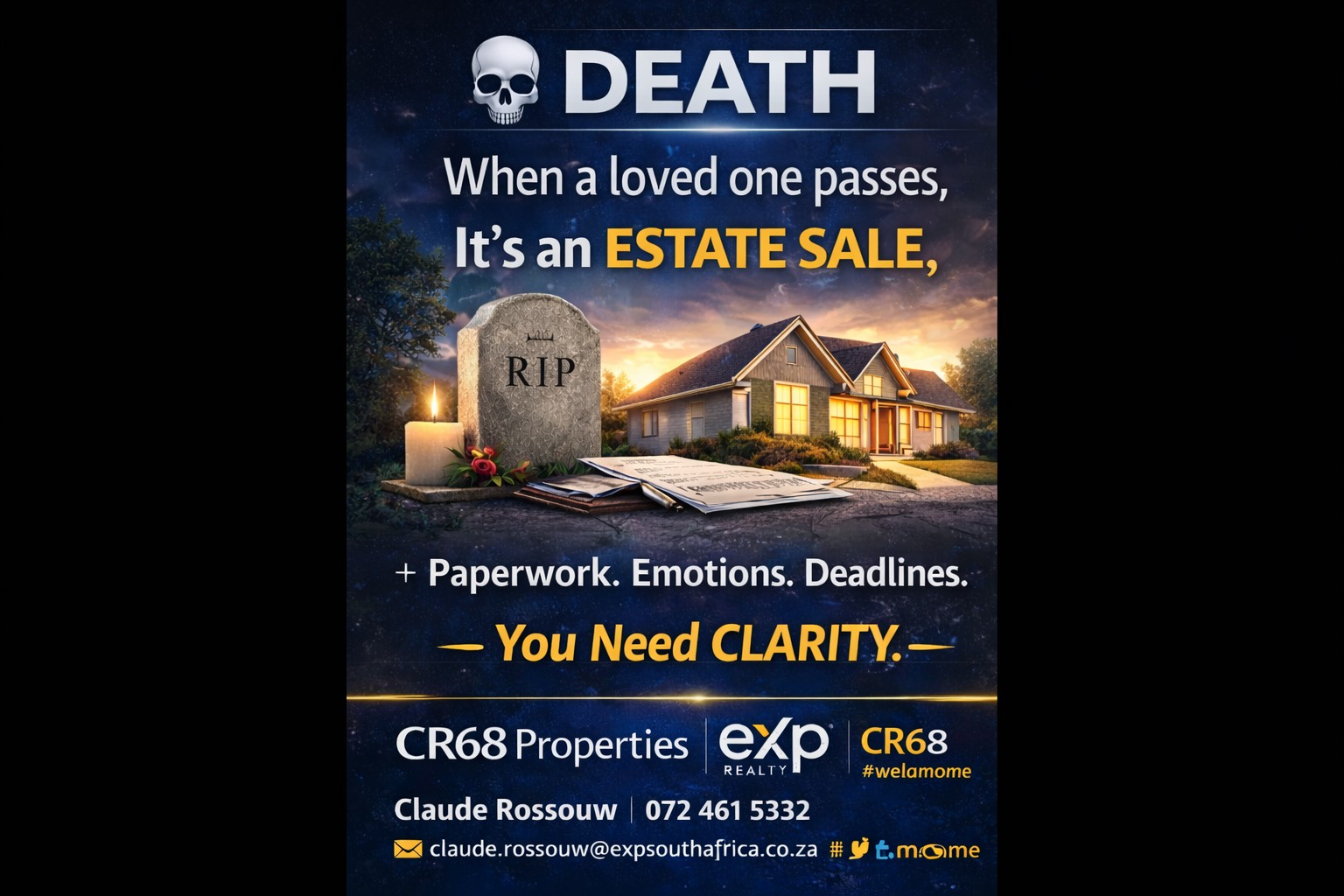
The D Nobody Likes Talking About: Death and Real Estate in South Africa
By Claude Rossouw – CR68 Properties | eXp Realty
One of the most common drivers of property sales has nothing to do with interest rates, market cycles, or investment strategy.
It’s death.
In real estate, we often refer to the “Four D’s” that trigger property movement:
Death, Divorce, Diapers, and Diamonds.
And while all four are deeply personal life events, death is by far the most emotionally and legally complex.
It’s a subject people avoid — until they have no choice.
When a Home Becomes an Estate
When a loved one passes away, the family home does not simply remain “a house”.
Legally, it becomes part of a deceased estate.
That means the property is no longer owned by an individual, but by the estate of the deceased. From that moment on, specific legal processes must be followed, regardless of how urgent or emotional the situation may be.
This is often where families feel overwhelmed — because grief and legal procedure arrive at the same time.
Grief doesn’t come with a manual. Unfortunately, estates do.
The First Step: Reporting the Estate
The first and most important step is that the death must be reported to the Master of the High Court.
This sets the legal process in motion and determines whether:
An Executor will be appointed (for larger estates), or
A Representative will be appointed (for smaller estates)
Until this happens, no one has legal authority to sell, transfer, or even formally market the property.
This authority is granted through:
Letters of Executorship, or
Letters of Authority
Without these documents, no transaction can proceed — even if all heirs agree.
In estates, urgency never beats authority.
Key Documents in Deceased Estate Property Matters
While every estate is different, the following documents are commonly required when a property forms part of a deceased estate:
Death Certificate
Deceased’s Identity Document
Marriage Certificate (or Divorce Order, if applicable)
The Will (if one exists)
Title Deed of the property
Bond Statement (if bonded)
Municipal account
Letters of Authority / Executorship
Many families worry because they don’t have everything immediately. This is completely normal.
Part of my role is assisting families to identify what’s missing, request duplicates, and coordinate with attorneys and institutions to gather the correct documentation.
You inherit memories… and paperwork.
How Deceased Estate Property Sales Work
Once authority has been granted by the Master:
The property may be marketed
An Offer to Purchase can be accepted
The sale proceeds are paid into the estate account, not to individuals
Outstanding debts and costs are settled first
Only thereafter are heirs paid their inheritance
This process exists to protect all parties involved — even when it feels slow.
Shortcuts in estate matters often create long-term legal problems.
Fast deals are good. Correct deals are better.
My Role in These Matters
I specialise in deceased estate property transactions, and I approach them with one core principle:
Remove pressure, not responsibility.
My role includes:
Guiding families through the property process step by step
Working closely with executors, attorneys, and heirs
Ensuring legal compliance at every stage
Creating clarity during a time that feels emotionally heavy
Most importantly, I understand that this is not “just a sale”.
It’s often the closing of a chapter.
Even in loss, clarity is kindness.
A Gentle Truth
Estate matters take time.
Anyone promising instant solutions or “quick fixes” is usually creating future problems. My focus is on doing things properly, transparently, and with dignity.
Slow is smooth. Smooth is fast.
Final Thoughts
If you are dealing with the loss of a loved one and there is a property involved, you don’t need opinions, pressure, or noise.
You need:
Experience
Structure
Calm guidance
I’m Claude Rossouw from CR68 Properties | eXp Realty, and I assist families in navigating this process correctly — with respect for both the law and the emotions involved.